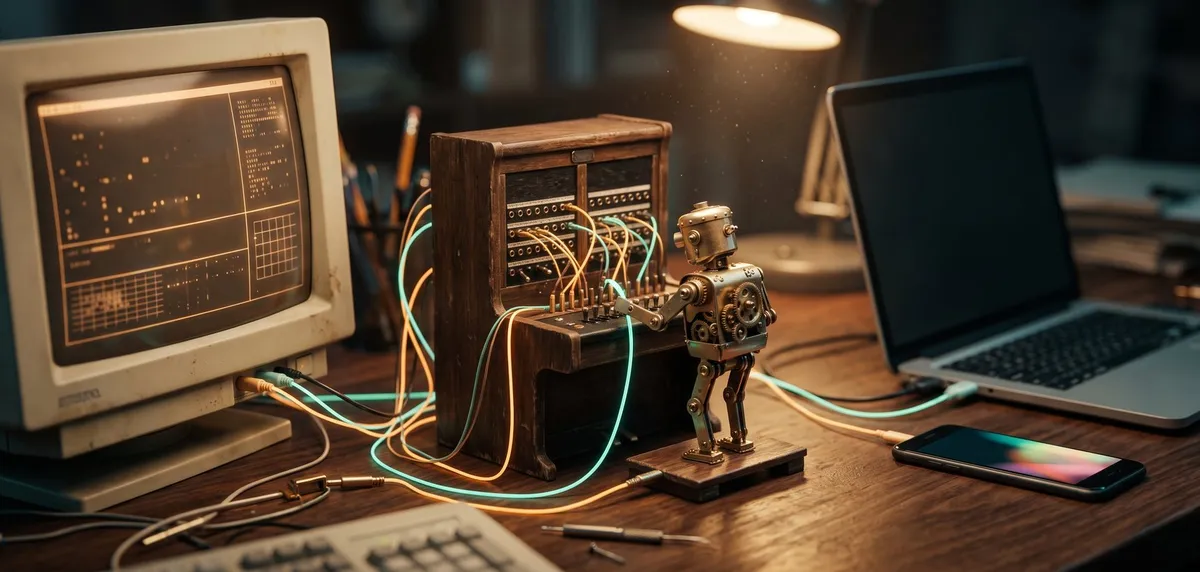
More and more of my work starts in one of two agents instead of in the app the work belongs to. Between them, Grok Bot and Claude Code handle a lot of my email and calendar, track my investments with dashboards, create and edit documents and spreadsheets, download, file, and summarize all kinds of files, and plan travel down to a detailed itinerary. I still ultimately push send on my own, and I still open apps, but I spend a lot of my day in these two.
When I call them my operating system, I mean the layer I actually touch, the way a shell is what you type at on a computer. Gmail, Google Docs, my calendar, and Cloudflare all still run underneath. What I care about most is the part below that layer, which decides what the agents are allowed to do, how long that access lasts, and what record it leaves.
Grok Bot handles most of the day-to-day: reading and drafting email, scheduling, travel, images, and digging into things I find on X. Its chat-style interface is a big part of why that works. I use it in the browser, in its app, and on my phone, often by voice, the same way I'd message a person, and I'd really like it on my Apple Watch. Someone has already built an unofficial watch app that works, slowly, since there's no official Grok Bot API yet.
Claude Code handles the building. It built the dashboards I use to track my investments, working from statements I still download myself. My last two Field Notes came out of Claude Code sessions too. It researched and drafted them from my notes and direction, and I went back and forth with it on every draft. It also made the hero images, had other companies' models review them, opened and merged the pull requests that published them, and turned analytics back on through Cloudflare's API instead of me clicking through the dashboard.
I use Claude Code mostly in the terminal and its desktop app, and moving between those and Grok Bot's browser, app, and phone feels fluid. I jump in and out of the terminal far more than I have since the days before web browsers.
I'm not the first to reach for this comparison. Every's newsletter recently ran ChatGPT Wants to Be Your Operating System about OpenAI's ambitions, and Yuchen Jin, who has moved to a desktop app, argues that the terminal is the wrong interface for coding agents. SymoneBeez lets Grok Bot read and reply across four email addresses, while I still send my own.
Two agents, two halves of one system
Where each one runs turns out to matter: Grok Bot runs in xAI's cloud and keeps working while I'm away. Its computer is shared by all of my Bots, and xAI's documentation says plainly that files, signed-in browser sessions, and command-line credentials on it are available to every Bot. Claude Code runs on my laptop, in my files and my terminal, mostly while I'm watching, even though the model behind it runs in Anthropic's cloud.
So the thing I'm calling my operating system is spread across my laptop and someone else's cloud, and the two halves have different permissions and leave different records. My Claude Code sessions end up in a local archive I can search with AgentsView, which is a start even though it isn't a full record of what allowed each action. Grok Bot's don't, and I don't have anything comparable for it yet.
DHH's Omarchy, which calls itself the malleable OS for the age of agents, points at the same fork from the other side. I haven't used it, but its site describes a desktop that invites you to pick a default agent and ships skills for agents to work on the machine itself. Grok Bot, Meta's Muse, and OpenAI's Dots go the other way: each runs a machine in the vendor's cloud and puts a conversation in front of it, so less of the computing has to happen on the laptop in front of me.
In March I wrote that the agents are the computer, borrowing from Sun Microsystems' old line that the network is the computer. Seven months later, that's how my own setup works: the computer I depend on increasingly sits behind the agent, wherever the agent runs it.
Where I still go back to the apps
Sometimes I just need to look at a map, a photo, or a diagram, and a description of it isn't the same thing. Video is similar. An agent doesn't replace YouTube for me, even though more and more of what I watch is obviously and intentionally made by AI, and my own images are too. My latest obsession is slopcore, AI-made music videos that lean into the machine-made look on purpose, like P DOOM from Astra Blue AI and The Clodyssey by anabology. OpenAI's new Intelligent UI, which puts charts, small tools, and even maps into ChatGPT's answers, suggests the vendors know about the visual gap.
I'm still the one who hits send
Grok Bot drafts my email and I send it. It helps me plan trips and I do the booking. Claude Code published my notes and changed Cloudflare only after I said go. I keep the decision on anything that goes out under my name or costs money. That's a habit, though, not a control, and I have evidence of how far a habit goes: I recently sent a text meant for my wife to one of my Bots instead. The chat sits close enough to my real conversations that the slip was easy.
Anthropic found that approvals wear down: Claude Code users approved roughly 93% of permission prompts and paid less attention to each one the more of them they saw, and I worry I'll give my own final check less attention as I get used to the agents being right. My check also only covers what goes out, and Grok Bot reads my inbox, which is full of other people's instructions, on a computer shared by all my Bots, so it can be steered long before I'm asked to approve anything.
That's why I keep asking for the same things I wrote about in Superintelligence Is a Permissions Problem: narrow grants that expire, a record of what the agent did and what allowed it, and a way to see everything done in my name after the fact. Apple is moving the same direction on consent: it told Mac developers it will require more explicit consent before an app gets Full Disk Access, which covers part of that list. The desktop I need is getting thinner, while the permissions and logs beneath it matter more.
A glimpse of the next layer
On October 15, Meta released open weights for Muse Spark Open, which it calls the most capable US open-weight model to date, and showed Muse Code running agent workflows entirely on two Apple M5 Ultra Mac Studios. The same company that runs its Muse agent on a computer in its own cloud is now also offering a model you can run at home, as long as home includes some serious hardware.
That hardware is expensive today, and I haven't run the model myself. It's still a glimpse of the piece I'd like to add to my operating system next: a top-tier model on hardware I control, alongside Grok Bot in the cloud and Claude Code on my laptop. Its permissions and its records would live on my own machines, and it would keep working through the outages, price changes, and account problems that worry me most.
What I'm watching
The biggest risk to my setup today is dependency. If two agents are how I reach most of my work, a problem at either company would push me back into the apps underneath, which are still there but which I use less and less directly. That's the slow slide I described in When You Can't Pull the Plug, and it's why a model I can run myself matters to me.
I'm also noticing what I give up. Reading an inbox yourself picks up things a summary tends to leave out, like tone and who dropped off a thread, and writing from a blank page is how a lot of people work out what they think. I'm doing less of both than I used to. I want to spend less time operating applications while still understanding everything that gets done in my name, and for the half of my setup that runs in someone else's cloud, I don't have the record that would let me do that yet.
I'm curious what other people have stopped opening. If an agent has replaced an app you used to live in, I'd like to hear about it on X, LinkedIn, or at contact@exagentica.ai.